
'While I was performing it, I had a weird feeling that people would love it because it's so bizarre.'

Some believe that, as prime minister, Sunak will be particularly friendly to India and that he would return the Kohinoor and do similar gestures to his motherland. Such wishful thinking is not likely to materialise as he will act in the best interests of the UK and will not even appear to favour India, argues Ambassador T P Sreenivasan.

I think the 'What-if-it-had-been-Patel?' sentiment represents a yearning for more of what we are already seeing around us in India today, observes Aakar Patel.

British writer and historian Patrick French has died in London after battling cancer for four years, his family announced on Thursday.
'But he was very quick and did a very stylish adab.' 'Of course, I didn't expect him to hug.'

'Extinguishing the eternal flame at India Gate is nothing short of a crime'

Bharati Dutt witnessed life-changing events that shaped India on the threshold of freedom. Her memories are an account of how ordinary Indians saw India change.

Some major events that occurred from 1885, when the Indian National Congress was formed, till August 15, 1947, when India achieved Independence.

There were Vedic mantras engraved along with prayer songs for Lord Shiva, Lord Rama and Lord Krishna. Neither the government nor the people of Faisalabad demanded that the carvings be removed. I felt very happy to see Sanskrit shloka

Who rocked the sari style best in the British Raj? Sukanya Verma asks you to take a poll.

The Gujarati's intolerance for diversity can be seen in India's hard nationalism which is showing itself in Kashmir and the North East, observes Aakar Patel.

'I told them I am a Muslim, you are Sikh, you are Hindu, but we have one country to save.'

The opposition party also said that it would like to remind the BJP that Hindu Mahasabha president Syama Prasad Mookerjee aligned with Jinnah's Muslim League to form the government in Bengal during the British rule.

Sam Bahadur is a mechanical summary of his life, ticking off one chapter after another without bothering to pause or ponder over their significance and influences, observes Sukanya Verma.

Historian Stanley Wolpert's book -- Shameful Flight -- revisits Partition, and lays the blame for one of the most horrific episodes of the 20th century squarely on the shoulders of a Briton, finds Arthur J Pais.

'It is only because of the Congress that we became a secular republic.' 'As we enter a period where another political force has became dominant, it will be interesting to see if this legacy of Nehru and the Congress is sustained or we are taken in a new direction,' says Aakar Patel.

Sukanya Verma recaps all those events from 25 years ago.

"India has given a stern signal to its enemies by conducting surgical and air strikes. This tells us that India is changing and can take the most difficult decisions and isn't reluctant to implement them," Prime Minister Narendra Modi said on Sunday in his Independence Day address to the nation.

If the Indian son-in-law can become prime minister in another country, could the daughter-in-law have not become one here, especially considering that the Indian culture and tradition is for the bahu to live, think and act like her in-laws, asks N Sathiya Moorthy.
'What Jaishankar says is simplistic.' 'The past does not matter that much.' 'If we think that it does it is because we are not good enough at running the nation competently today and are searching for excuses why,' argues Aakar Patel.
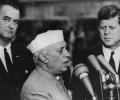
On Jawaharlal Nehru's 134th birth anniversary, Utkarsh Mishra recounts incidents where the first prime minister showed exemplary courage, bravery and integrity.

'I can tell you the case that hurts me the most is the one in which the little boy is forced to sign the Kohinoor over.' 'You take a mother away from a child, you surround him with grown ups speaking a different language, you tell him he must sign this over or else...'

Bhagat Singh was born on September 28, 1907 in Banga village in Lyallpur district, now Faisalabad in Pakistan Punjab.

'Our biggest problem has been keeping this country together.' 'Nation building is never easy. It is a very difficult task.' 'Even 70 years is not too long a time.'
The elegant architecture, tree-lined roads, delightful gardens, delicious food, art and military history make Chandigarh an ideal short-trip destination.
'Non-separation of religion from politics is India's most daunting challenge'

'The upper caste elite's belief that they are casteless is a belief that is available only to the upper castes. Because all the lower castes are reminded by society every day what their caste is.'

The attack on Rushdie sent shock waves around the world, with world leaders and literary stalwarts saying they were appalled at the attack on the author who championed free speech and lived under the threat of assassination for nearly half his life.

What if Lagaan was remade today? Sukanya Verma picks actors best suited for the key roles.

A movie that seeks to explore an 'alternate history' cannot be so superficial, sighs Utkarsh Mishra.

'Imagine for a soldier -- first you conquer territory after fighting a fierce battle, suffer casualties and then you are ordered to come back to your side of the International Border in India.'

Today, the two countries, ruthlessly divided by the Radcliffe line that pierced their very heart, grapple with the political challenges of the present. Yet, when friendships develop there are no borders, observes Payal Singh Mohanka.
'I am very grateful to Rajnathji that he confirmed the fact that Savarkar was a habitual mercy-seeker from the British.'

'The Maoists want the tribals to boycott the election while the police think the election is a farce and do not want to risk going deeper in the conflict zone.' 'Newton (played with sincerity and deep felt passion by Rajkummar Rao) wants to make sure that the locals cast their vote, a right given to them by the Constitution.'

'The obsession of the Pakistan army with India leads to several destabilising things. Support for the Taliban in Afghanistan. Support for groups like the Lashkar-e-Tayiba, that have attacked India. Every time you get an attack like that there is a possibility of a war. And then the build up of the their nuclear arsenals. Chances of a nuclear weapon landing in the hands of a terrorist group, or a nuclear war breaking out, are tiny. But they are higher here than anywhere else in the world.'

The actor, known for her provocative and often inflammatory statements, posted a series of questions on Instagram, also bringing in Partition as well as Mahatma Gandhi and alleging that he let Bhagat Singh die and did not support Subhas Chandra Bose.

The Assam-Mizoram violence is an outcome of BJP trying too hard to 'integrate' distinct northeastern states, explains Shekhar Gupta.

"He was an icon of the Indian history and will remain so. There can be a difference of opinion about him, but to look down on him as inferior is not appropriate and justifiable. He was a freedom fighter and a staunch nationalist, but people who follow the Marxist and Leninist ideology are the ones who accuse Savarkar of being a fascist...," Singh said, adding that the hatred towards Savarkar is illogical and unplaced.

'Prime Minister Modi is from Gujarat and so does not understand the importance of the Jallianwala Bagh massacre to Punjabis,' says the British MP fighting for an apology for the Jallianwala Bagh massacre.

The Moplah rebellion, also known as the Mappila riots, of 1921 was one of the first manifestations of the Taliban mindset in India and the Left government in Kerala was allegedly trying to whitewash it by celebrating it as a communist revolution, Rashtriya Swayasevak Sangh leader Ram Madhav claimed on Thursday.
